We use cookies where necessary to allow us to understand how people interact with our website and content, so that we can continue to improve our service.
We only ever receive anonymous information, and cannot track you across other websites. View our privacy policy

“I think the message from the Portuguese people was clear. We lead the right in Portugal, we lead the right-wing space in Portugal, and we will soon govern this country.” André Ventura, Leader of Chega & Presidential Candidate
These are probably not the words that you would associate with someone who has just lost an election. Nevertheless, the defeated André Ventura of the radical right Chega party was in a buoyant mood despite winning only a third of the vote in the Portuguese presidential run-off against Socialist António José Seguro. So why was Ventura in such high spirits?
What do Chega believe?
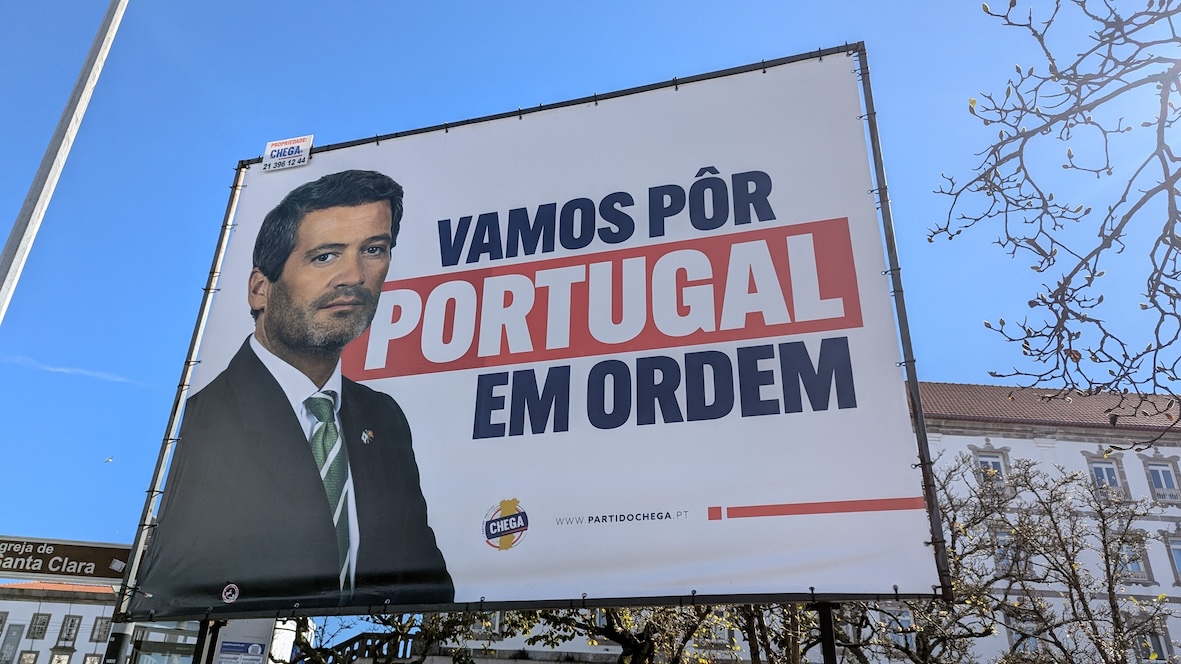
Chega’s meteoric rise since their founding in 2019 mirrors that of many radical right groups across Europe, as issues like migration and inequality are weaponised for electoral advantage. Campaigning on an anti-immigrant, anti-LGBTQ+, and anti-Roma narrative, Chega has embraced the politics of ‘othering’, separating Portuguese society between an ‘us and them’ dichotomy .
Like Reform UK, the party is also keen to portray a picture of economic governance that is broken and corrupt. Taxpayers’ money is said to be wasted, the civil service bloated, and the welfare system exploited. Attacks on those seen as gaming the system can be seen in the party’s slogan, “God, country, family, and work” – an updated version of Portuguese dictator António de Oliveira Salazar’s slogan, “God, country, family.”
Recent Portuguese elections have seen Chega gatecrash the two-party hegemony of the centre-right Social Democratic Party and the left-wing Socialist Party. Between the first Portuguese legislative elections, held one year after the 1974 Carnation Revolution that overthrew Portugal’s 48-year authoritarian Estado Novo regime, and the 2022 legislative elections, which saw Chega break through into mainstream politics, the Socialists and Social Democrats averaged around 70% of the vote. In the last two elections they have averaged just over 55%.
The latest opinion polling, taken in January this year, has Chega trailing the Social Democratic Party by just over one point – a marked decrease from the nine-point lead the Social Democrats enjoyed less than nine months ago. The results of the first round of the presidential election further forecast the changing tides. André Ventura secured second place in that race by gaining more than twice as many votes as his Social Democratic counterpart. It is this result that Ventura has used to claim that his Chega party is now leading the “right-wing space”.
Uniting the right
Politics in the 2020s is unkind to incumbents. Where parties could once reliably expect two or perhaps three terms in office, the new modus operandi is a ‘one and done’ state of affairs. Whether it is the unceremonious dumping of the SPD in Germany after four years, the dismal ratings of the Labour Party in the UK after less than two years, or Biden’s one-term presidency in America, voters are increasingly hungry for results, and fast.
Perhaps because of this, it is increasingly important for parties to position themselves as the dominant opposition, whether officially or otherwise. Radical right parties have recognised this more acutely than others. Ventura’s celebrations were not driven by the result itself, but by what it meant for his insurgent party as ‘the’ right-wing alternative. Much like Reform UK in our country or the AfD in Germany, Chega is now positioned as ‘the alternative’ to decades of two-party rule.
Radical right parties understand that legitimacy matters. Nigel Farage spoke of establishing “a bridgehead in Parliament” after the 2024 General Election, before adding to his party’s momentum in last year’s mayoral and local elections. Each victory for a radical right party, at a national or local level, normalises these parties’ views to voters. No where is this clearer to see than the worrying normalisation of xenaphobic politics by radical right groups across Europe. Topics such as remigration, once confined to the peripheries of extremist thought, are now spoken about openly by parties with genuine ambitions of forming governments.
Momentum builds within political movements. While the number of failed former Tory ministers may eventually hurt Reform UK in the polls, the arrival of MPs such as Tory leadership hopeful Robert Jenrick is a sign that those on the right of British politics are prepared to abandon their allegiance for another shot at power and see Reform UK as the best vehicle to achieve their goals. The results of the Scottish, Welsh, and local elections on May 7 may well reinforce the belief among those on the right of British politics that Reform UK can beat both Labour and the Conservatives at election time.
For André Ventura, the last two election results have shown the Portuguese public that his party can beat the Socialists and Social Democrats in national elections. If the ruling Social Democratic Party and the left-wing Socialist Party continue to slide in the polls, Ventura may be confident that, come the next legislative election, his party may not just be the official opposition, but the government in waiting.
Sign up for our newsletter
Get our research, campaigns, and analysis in your inbox. No spin, no noise — just the evidence-led case for a better Britain.