We use cookies where necessary to allow us to understand how people interact with our website and content, so that we can continue to improve our service.
We only ever receive anonymous information, and cannot track you across other websites. View our privacy policy

Try and picture this. A Labour Party flailing in the polls less than a year before an election, a centre-right Conservative party decimated by a radical right alternative, a wealth tax on the front pages, a fragmented party system, and no mainstream party daring to mention the EU. Easy right? Except on Monday it was the Norwegian Labour Party overturning an eight point deficit in the polls to win a general election and fight off the right-wing populist threat. So what happened?
In early December 2024, the Norwegian Labour party reached one of their lowest polling scores on record. The meagre 17% recorded painted an ugly picture. Trailing both the Norwegian Conservative Party whom they had replaced in government in 2021 and the radical right Progress Party, defeat seemed inevitable and the prospect of a second term increasingly unlikely.
However, late on the 8th September 2025 it was announced that Labour and their left-wing allies had won enough seats to form a government in Norway’s system of proportional representation that often creates broader coalitions of right – or left – leaning parties. Gaute Børstad Skjervø, leader of Labour’s youth party, labelled the victory “the comeback of the ages in Norwegian politics”, while the re-elected Prime Minister Jonas Gahr Støre told supporters that it is “possible for the Social Democrats to win elections even when right-wing forces are on the rise in Europe”. So what can the UK learn from this stunning turnaround?
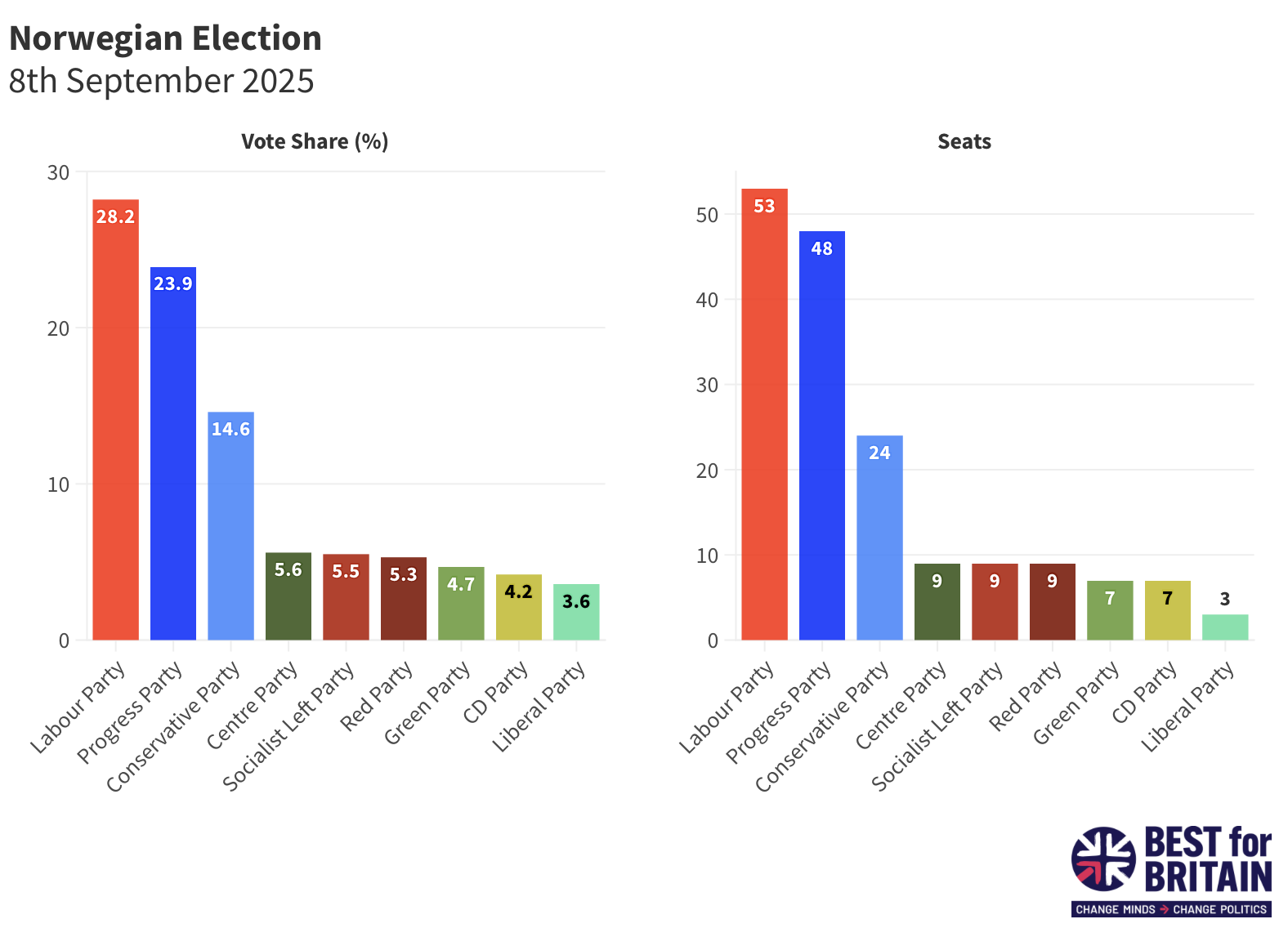
Interesting for UK observers is seeing how recognisable political dynamics play out in a proportional system. Both Norway and the UK have a more radical populist force consuming their traditional conservative party and both have seen greater political fragmentation With the creation of ‘Your Party’ by Jeremy Corbyn and Zarah Sultana there are now 14 political parties represented in the British House of Commons.
Ten years ago, the Norwegian Conservative and Labour Parties enjoyed a cumulative polling total of 64% – likewise at the 2015 UK General Election our two main parties enjoyed a cumulative vote share of just shy of 66%. Fast forward a decade and the two historically dominant parties of Norway have picked up almost 43% of the vote whilst their British counterparts are languishing on a cumulative 37% in the polls as both Keir Starmer and Kemi Badenoch bleed support.
However, unlike the British system of first-past-the-post which rewards concentration of support and delivers remarkably unrepresentative results – the Norwegian system of proportional representation delivers (as one would hope) proportional results. Not only does this encourage the building of coalitions, compromise, and a more democratic form of governance but proportional representation appears to increase turnout come election time.
Norway regularly sees over 75% turnout, as do fellow followers of proportional representation such as Sweden, Germany and Denmark. In comparison, the UK’s turnout dropped below 60% for the second time this century at the last election, with comparative countries like the US and Canada experiencing similarly low turnout throughout the 21st century.
The Norwegian system demands cooperation. To win the 85 seats in the Norwegian parliament required to form a government involves building a broad and inclusive coalition. To form his second government Prime Minister Støre will have to work alongside the Socialist Left, the Greens, the Red Party and the Centre Party. Despite not operating in a system of proportional representation our own government seems to have forgotten the progressive coalition that swept them to power last year, who they are now alienating in a futile attempt to appeal to those now saying they plan to vote for Reform UK. In fact research undertaken by YouGov on behalf of Best for Britain aimed at Decoding Populism suggests that of those who say they intend to vote for Reform only a small minority would consider voting for Labour – as low as 1% for large segments of those intending to vote for Reform UK.
Analysis by the British Election Survey suggests that; “Labour faces more direct competition from the Liberal Democrats and Greens than it does Reform – at least in terms of maintaining its 2024 voter base”. Labour have lost more than twice as many of their 2024 electoral coalition to the Liberal Democrats and Greens (17%) than Reform (8%) since winning the last election.
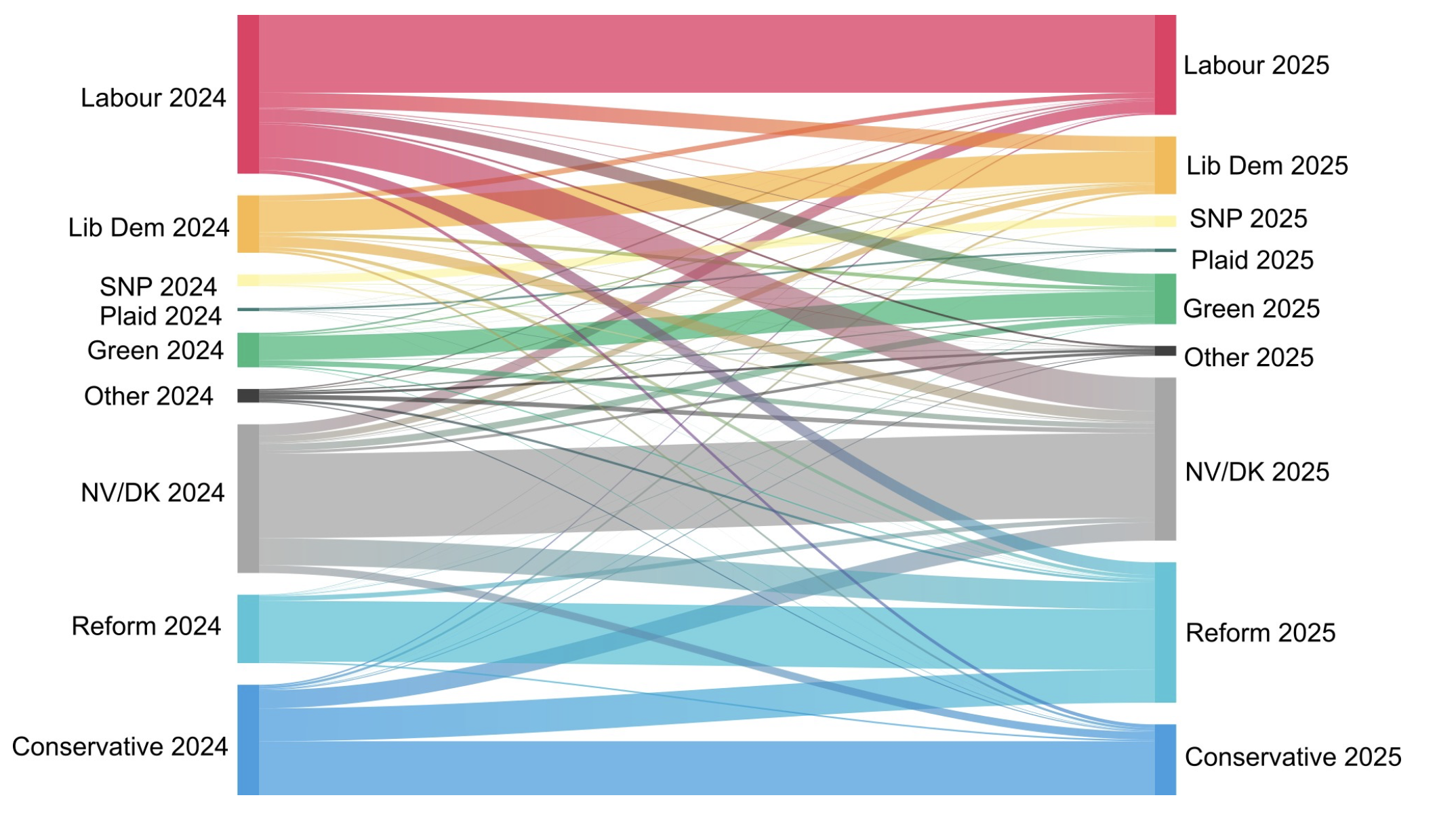
British Election Study (2025) – ‘Looking for Labour’s lost voters’
Despite British Labour currently polling at around 20%, the cumulative total of the Greens, the Liberal Democrats, and Labour currently sits at around 44% of the vote. On the other side of the aisle the Conservatives and Reform UK total around 48% of the vote. Choosing to pursue policies which are fundamentally popular for each of these progressive voting groups would offer Starmer a much greater chance of winning the next General Election.
For example, when we look at how this broader progressive coalition views closer relations with the EU, a vital opportunity for the government arises. When asked whether they would support or oppose the UK aligning with all EU rules and regulations to secure a better trading relationship with Europe more than two-thirds of the progressive coalition are in favour (Labour 71%, Liberal Democrats 69%, Greens 68%). Other left-friendly areas like climate action, free healthcare,social security and a closer relationship with Europe are even popular with certain sections of Reform’s support base.
While Norway enjoys access to the Single Market and a close relationship with the EU that removes costs for businesses, Starmer is stuck with a quagmire of Brexit barriers and red tape throttling growth opportunities. Starmer can shore up those most at risk within his 2024 coalition and lower the cost of living for Brits across the country with a single policy direction. If Starmer is to see off the challenge of Farage he must pull the most effective lever of growth, removing trade barriers and moving further and faster on alignment with Europe. Not only will this put more money in people’s pockets but it will likely endear Starmer to the progressive voters he will rely on at the next General Election.
The victory of a progressive coalition in Norway is a welcome tonic to the advance of the radical right across Europe. In a world upturned by geopolitical instability, it is a reminder that building a collaborative progressive coalition is achievable. But despite the similarities between the UK and Norway, the Westminster winner-takes-all system leaves Starmer more vulnerable to the populist right than his Norwegian counterpart. It is crucial that Starmer remembers who his coalition is. Rejecting attempts to pander to Reform and understanding that it is the left that he has more chance of winning or losing.